

Relational Puppetry
A deeper look at the methodology
Relational Puppetry is a way of entering interaction with children that places
relationship, safety, and indirect contact at the center.
It is not a technique you apply, but a way of thinking about how interaction begins -
especially in moments where direct contact feels difficult or increases pressure.
Explore the core ideas behind Relational Puppetry and how they work together.
Entering interaction differently
In many professional settings, interaction starts with you as the adult stepping forward: asking questions, offering help,
or trying to guide the situation.
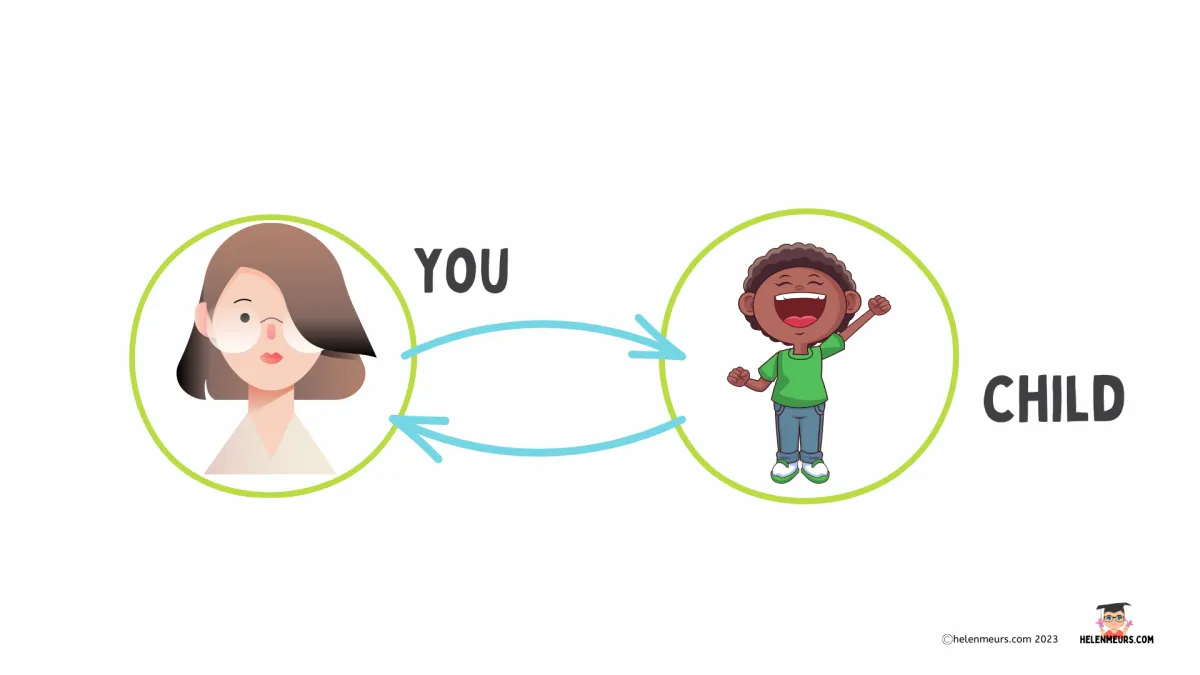
While well-intended, this can unintentionally increase pressure for some children.
They may withdraw, resist, or become quiet - not because they don’t want contact,
but because direct adult attention feels too much.
Relational Puppetry starts from a different premise:
What changes when you step back - and something that feels safer steps in?
The puppet as a safe third
At the heart of Relational Puppetry is the concept of the safe third.
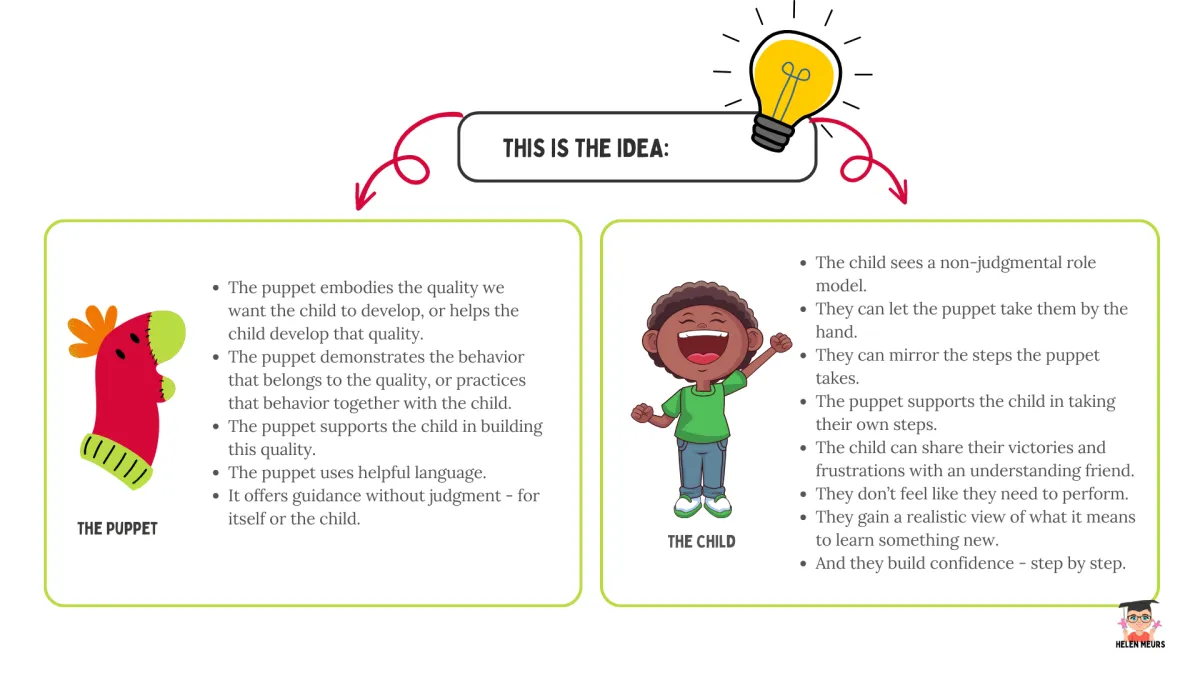
The puppet is neither a toy nor an extension of you.
It is an independent presence, free from adult authority, expectations, or judgment.
Because the puppet is not “the adult,” social pressure drops.
Children are not being evaluated, corrected, or guided - they are simply being met.
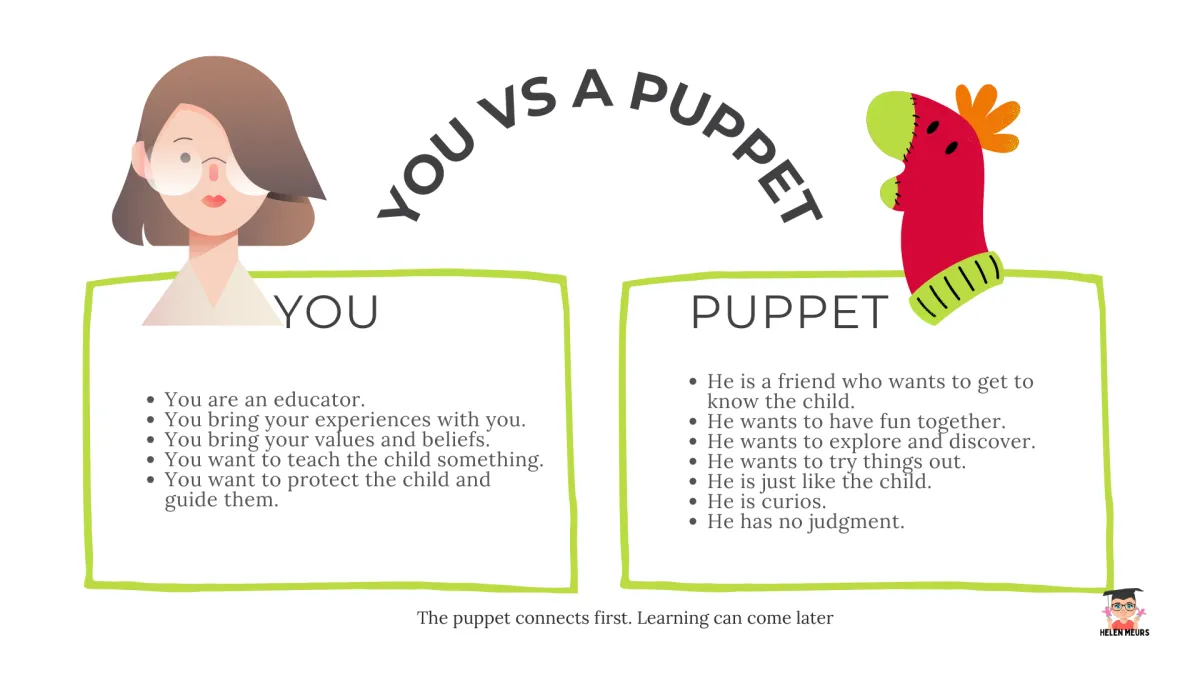
This indirectness matters.
It creates a space where children who usually shut down may feel able to respond, explore, or share.
The puppet becomes a bridge
between the child’s inner world
and you.
The communication triangle
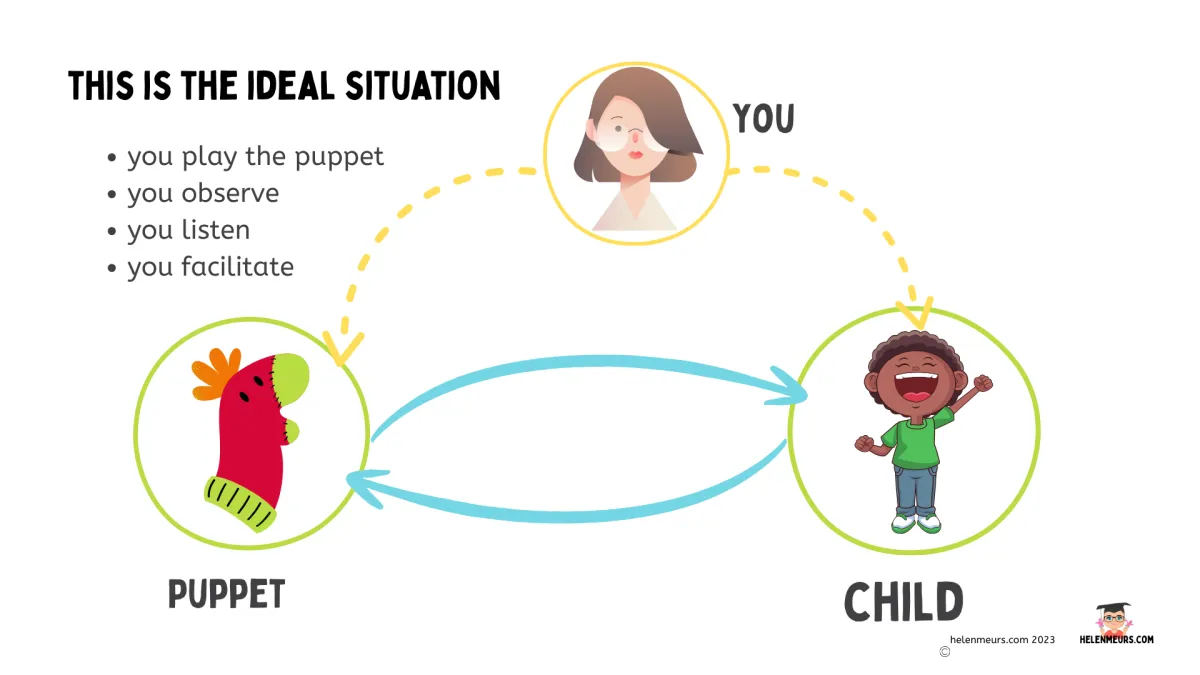
Relational Puppetry creates a triangular relationship:
between the child, the puppet, and you.
Your role shifts.
Instead of being the direct conversational partner, you become the facilitator of the interaction.
You stay present, attentive, and responsive -
but you allow the puppet to hold the relational focus.
This does not mean you disappear.
It means you become transparent.
A guiding phrase within this methodology is:
When you step back, the child steps in.
By stepping out of the center, you make space for the child to engage on their own terms.
The posture of the puppet (UNO)
For the puppet to function as a safe third, its posture matters.
Within Relational Puppetry, the puppet is:
Uninformed
The puppet does not know and does not explain.
It asks questions instead of offering answers.Non-solutional
The puppet does not rush to fix or resolve.
It stays with the experience rather than steering toward outcomes.Open-minded
The puppet has no judgment, no agenda, and no hidden goal.
When a puppet behaves too much like the adult - instructing, correcting, or guiding -
children often disengage.
The puppet loses its relational power.
Friend, not educator
In Relational Puppetry, the puppet meets the child on equal ground.
It makes mistakes.
It hesitates.
It wonders aloud.
The puppet isn't there to teach, correct, or evaluate.
It stands beside the child, not above them.
This peer-like position is essential.
It allows the child to stay curious, rather than defensive.
And it keeps the interaction relational rather than instructional.
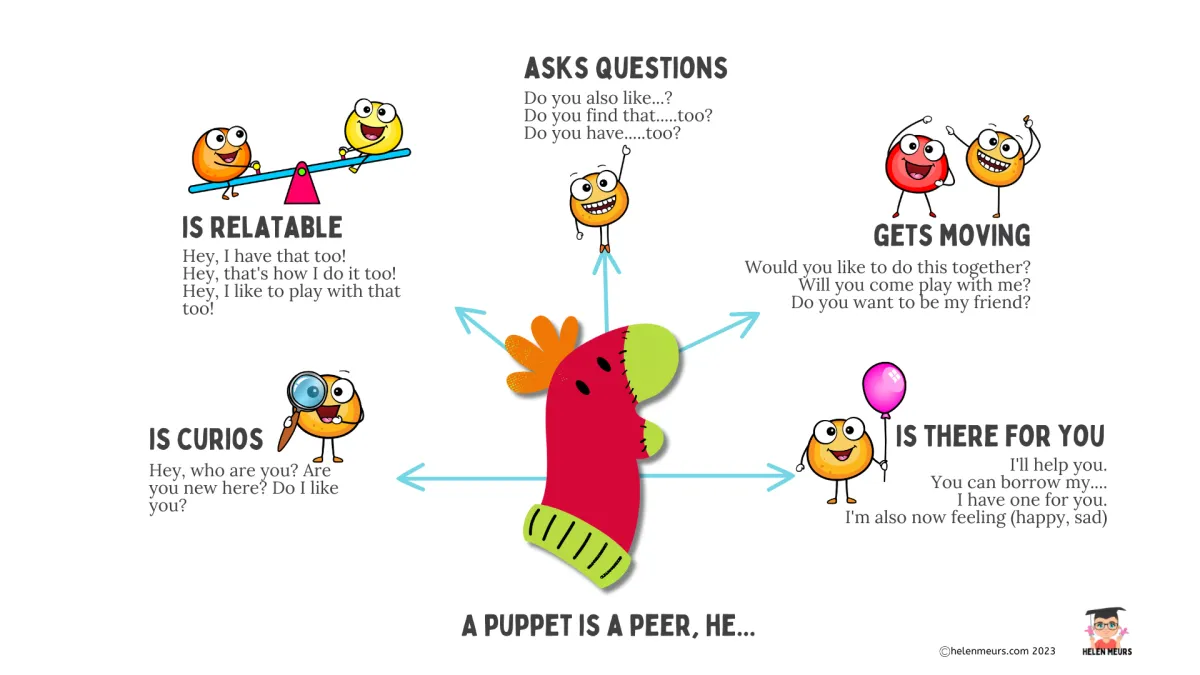
Connecting to the child’s world
The puppet speaks about what matters to the child:
daily experiences, interests, fears, small events that feel big.
It uses accessible, inviting language:
“Do you know that feeling?”
“I was wondering about something…”
By aligning with the child’s world of experience, participation becomes easier.
The child is not asked to perform, explain, or justify.
They are invited.
What this asks of you
Relational Puppetry is about learning new actions,
and about adopting a different stance.
It asks you to:
- tolerate not knowing right away
- resist the urge to fix or guide
- trust that interaction unfolds in its own time
- see stepping back as an active choice, not a passive one
It requires awareness, reflection, and intention.
What you already know remains relevant.
Relational Puppetry adds another layer to how you think and work.
What this makes possible
When pressure drops and interaction feels safer, children often:
- respond more freely
- share indirectly what matters to them
- experiment with language, emotion, or behavior
- participate at their own pace
Because the situation invites them in.
Through the puppet, you often receive information you would not have received otherwise.
How this differs from traditional puppetry
Professionals familiar with traditional or educational puppetry may need to adjust their expectations.
Because there is no “fourth wall.”
The puppet engages directly, waits, responds, and listens.
Believability matters more than perfection.
Children accept the adult voice as long as the puppet’s behavior feels consistent and real.
A realistic character
The puppet has a realistic, human character:
preferences, routines, worries, and everyday experiences.
This realism helps children recognize themselves in the puppet.
The puppet becomes a believable companion, not a caricature.
The intention
Relational Puppetry is about inviting children into a conversation or activity.
By creating interaction that is accessible, indirect, and safe,
children are more likely to step in - in their own way, and in their own time.
About this methodology
Relational Puppetry was developed by Helen Meurs, former teacher, trauma-informed educator,
and educational consultant, based on decades of hands-on work with children, parents and professionals.
It forms the foundation of her work.
This methodology is taught and practiced in her Building Bridges program.
Exploring further
If this way of thinking resonates, there are a few gentle ways to continue - depending on how you like to explore.
Learn through reading
On the blog, you’ll find reflections and articles that explore how Relational Puppetry shows up in
everyday situations - with children, in classrooms, and in one-on-one work.
Learn through seeing
On the YouTube channel, Helen shares short examples and explanations that make the relational dynamics
visible - without performance or show.
Learn by trying
If you’re curious what it feels like to work with a safe third, you can join a short, free mini course.
In just a few minutes, you’ll experience how stepping back - and letting something safer step in - can shift an interaction.
→ Join the free mini course
(experience the principle of the safe third in 5 minutes)Stay connected
If you’d like to stay close to the thinking behind Relational Puppetry, you can join the mailing list.
You’ll receive:
reflections and insights
practical examples
downloads and additional context
directly in your inbox.
Learn how this work is taught and practiced
In the Building Bridges program in Helen teaches you all the parts of Relational Puppetry - with structure, practice, and support.
→ Explore Building Bridges
Relational Puppetry creates space - so children choose to step in.