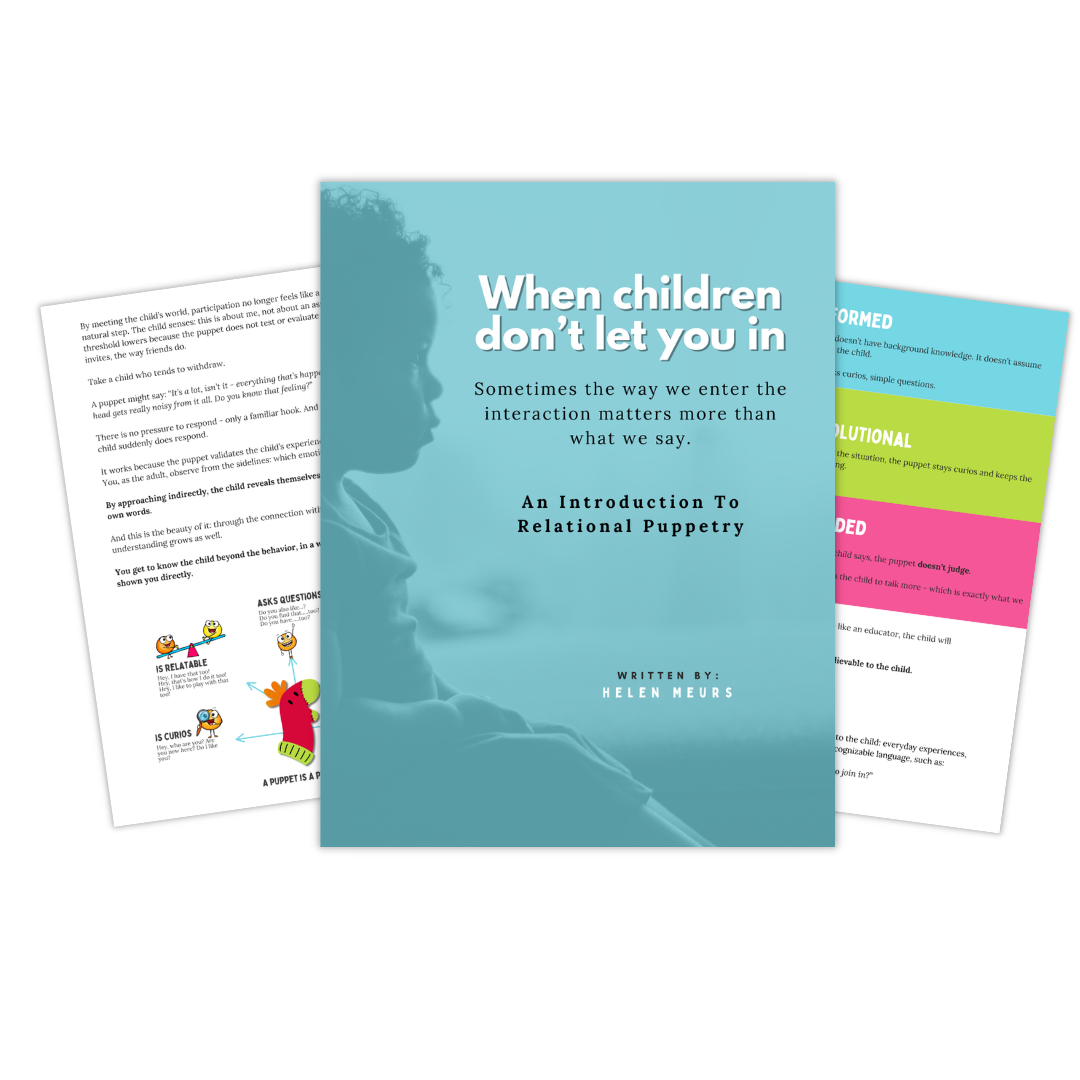
When children don’t let you in
Sometimes the way we enter the interaction matters more than what we say.
You work with children.
You understand that behavior has meaning.
And still, some interactions remain closed.
Children who withdraw.
Who resist.
Who don’t respond to direct adult contact - no matter how carefully you try.
When connection doesn’t happen, your work can feel heavy.
What if the problem isn’t the child?
What if pressure increases when you, as an adult, step forward?
What if talking more actually makes it harder for a child to respond?
In many situations, children don’t need better questions.
They need a different way in.
A way that lowers pressure.
A way that feels safe.
A way that meets them where they are.
Relational Puppetry
Relational Puppetry is a professional, relational methodology for working with children.
It uses a puppet as a safe intermediary -
an independent presence that creates access to a child’s inner world,
especially in situations where direct adult contact is difficult.
This is not about play for play’s sake.
It is about connection, trust, and emotional safety.
Not entertainment. Not performance. Not a trick.
It is not:
- a way to keep children busy
- a performance or role-play technique
- a tool to manage behavior
It is a way of working with a puppet that lowers thresholds -
so children feel safe enough to step in.
The puppet is used to invite the child into interaction.
This approach is grounded in pedagogy, therapeutic insight, learning psychology, and decades of practice.
The foundation of Relational Puppetry
Relational Puppetry rests on 3 clear principles:

The puppet as a safe third
An independent presence, free from adult authority or judgment.

The puppet as peer, not educator
Standing beside the child, not above them.

The adult stepping back
Facilitating connection rather than directing it.
Together, these principles shift the interaction -
often in subtle, but meaningful ways.
→ Read more about the principles of Relational Puppetry
When pressure drops, something else can happen
When interaction feels safer and more indirect, children often:
- respond more freely
- share indirectly what matters to them
- experiment with language, emotion, or behavior
- participate in their own way
Because the situation invites them in.
The puppet becomes a bridge
between the child’s inner world
and you.
Relational Puppetry may speak to you if…
- you think in terms of process rather than techniques
- you’re less interested in “what works” and more in why something shifts
- you see interaction as something co-created, not controlled
- you’re open to expanding how you enter contact with children
This approach adds another layer to how you think and work.
About this approach
Relational Puppetry was developed by Helen Meurs, former teacher,
trauma-informed educator, and educational consultant.
It grew from a simple question:
What changes when you step back - and something that feels safer steps in?
Over time, this question became a methodology.
Exploring further
If you’d like to continue exploring Relational Puppetry, there are a few gentle ways to do so:
Relational Puppetry is about creating space -
so children choose to step in.
Receive reflections, insights, and downloads
→ Join the Relational Puppetry mailing listLearn how this methodology is taught and practiced
→ Building Bridges
(the only program based on Relational Puppetry taught by Helen Meurs)
Download the free e-book
"When Children Don't Let You In"
Some children are just waiting for someone to try differently.
What if that someone is you?